No sir... The excellent Pentax K-70 (produced between 2016-2022 and frequently overlooked as an entry-level camera) allows to freely choose how you'd like your white balance increments: either in hundred Kelvin steps, or in MIRED, equal colour increments.
@tedarcher9120 Says:
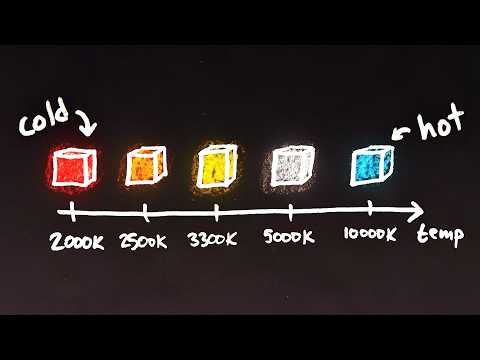
Wait, why is yellow image high temperature while blue is low temperature? This makes no sense
@opx4real Says:
When people say that you can just correct it later because it is shot in raw, and thus they don't need to worry about setting the correct color temperature. That is only discernably correct to a certain degree.
Everyone understands that dynamic range gets compressed as you increase the sensitivity, aka the ISO. But I don't think people understand that that dynamic range is not just the luminance, but also the color. Higher ISO images are more difficult to cleanly and correctly white balance, after the fact. However, setting the correct white balance and exposure can make a massive difference for the quality of an image, even when it is taken at a high sensitivity.
@BohdanManzhula Says:
Oh guys, this backgroung music is awful, everything else is perfect, yes, I really mean it.
@sandros94 Says:
For the past post scriptum: having a proper white balance from the start (before shooting) also helps you properly expose all channels, because you start noticing that in some areas you might be under/over-exposed. Correct light is always better than a fix in post
@BookWyrmOnAString Says:
Out of context "White Balance is broken" sounds like something a white supremacist would tweet
@Al_Gepe Says:
Wait, don't hotter objects (higher kelvin) glow more blue?
@Broockle Says:
Dang, and I live in Wien. I'm a proud Wiener 😀
@svampebobification Says:
Good job !
@mrs3lfd3s7ruc7 Says:
To explain a manager at those companies that there is need for a change somebody would need to pitch it in an appropriate way within 10 min, e.g. THIS video. How much time does it take to create such a video? I guess it takes multiple days at least if not a couple of weeks. Of course in those companies nobody has time to prepare a pitch like that which is the reason why to a knowledgeable person obvious things are not addressed.
@cookiejarseattle Says:
Yeah. Blame everything on us software engineers.
@jorgepeterbarton Says:
The main reason is the camera doesn't know what's supposed to be white in the frame. You can select 'custom' on some cameras to set by snapping a white card. But still then it won't know the context, for instance the 'cloudy' setting Vs 'auto' on a cloudy day is strikingly different because clouds make light very blue so you can correct colours so they appear as would in sun manually but somehow auto wants to make it very low K, and there's another argument that it could be even lower K so the blue reflects the weather conditions. All that's more important than the scale increments. I've tended to use manual when I can, because film had pretty good 'fixed' white balance and I think some of the 'warmth' actually comes from not overcorrecting too much.
@ftwgaming0 Says:
I really like how blurry things can be with super slow shutter speeds. With a frame of reference like the window of a train, things outside the window in the picture make it look like the train is moving a lot faster than it actually is but the problem I face with just my phone camera is that I can't make it as long as I actually want, but I also can't seem to make the exposure low enough to make the final image not look blindingly bright. I'm not educated at all in this field, I was just messing with the "pro mode" on my phone camera app one day, but I find it interesting none the less. Does anyone know why these limits are in place, and also know of a camera that can have an shutter speed of over a second? I wanna make it look like my train is moving at supersonic speeds.
@JoeSarah-z8s Says:
Hey, 14 years as a gaffer aka lighting guy here. I think there’s a practical reason why a linear colour temperature scale makes sense, even if it feels counterintuitive and to understand this we need to flip it back with lower Kelvin being warmer and higher being bluer and think in terms of lighting rather than cameras. Most real-world lighting falls within a fairly narrow range of roughly 3200K to 5600K. The variation in lighting situations we expect in the real world is greater at the warmer end than the cooler end, and it’s not evenly distributed. Think of the variety of colour temperatures between candlelight, fireplaces, tungsten bulbs, and sunsets all of which are close in colour versus that at the blue end with a huge jump from an overcast day to a blue sky.
@Ybalrid Says:
This is very funny. I had my nose in a Kodak book from 1985 "Mastering Colors" that explains Mireds and how they are a more useful unit because a filter (in this context they are correcting light balance on slide positive color film directly in camera with filters in front of the lens) have the same shift regardless of the color temperature. And that Kelvin are not linear like that...!
@ROGUEyoutube Says:
I wonder if the white balance bias is the reason that AI generated images have a proliferation for images with a yellow tint
@dwhughes1975 Says:
I find your choice of music in this video obtrusive. The off-kilter tonality is distracting and interferes with the mental process of assimilating the concepts. At least for me.
@danielchin1259 Says:
Script a bit repetitive? But thx for the vid
@Provuk Says:
Doesn't raw just solve this?
Edit: i just saw the end
@toxik420 Says:
God bless you man.
@DimaZheludko Says:
I always shoot in raw, so no prolem for me.
And yes, for video this is not an option, so you are right.
Also, if I remember correctly, in Lightroom color slider is non-linear. In Darktable as well, If I remember right.
@JamesDenghy Says:
So you may say, the mired is really in problems, can’t ya?
don’t kill me
@AbiSaysThings Says:
More and more of this channel is just you complaining about stuff scientifically but somehow the quality has not suffered 🤣
@DD-hz3ts Says:
This is why you use a white balance card and then correct in post
@nathanjohnson5304 Says:
We’re used to referring to white balance in its absolute kelvin, so I just use one of my presets that correspond to actually white balances I run into on a regular basis (3200K, 4400K, 5600K, 6300K). I don’t ever manually adjust white balance by looking at a screen, just scopes.
I’m happy to have small increments as I want to be VERY precise when I *do* manually adjust with scopes and need it to be fine adjustments.
You are correct in that what Canon does is actually best (scaled but with fine gradients), but I’m happy enough with Panasonic’s approach on their (now defunct) cinema line in that I can go as fine as 10K increments.
Photo cameras kind of have this with “Tungsten, Daylight, Shade, Cloudy” but that’s also problematic for obscuring too much.
I’m in full agreement concerning post-production software as the sliders are sometimes unusable in the low end and you have to manually type in small increments. Just have the slider indeed be proportional and still haven’t option to type in a value.
Cool video, excellent context and acknowledgements at the end.
@wil-fri Says:
Should be like 3d printers where You choose the step size
@skylerthacreator Says:
🍿😮
@celebcar.23 Says:
Great knowledge ❤
@theoharisgkagkos528 Says:
As a physics student and a photo enthusiast i am really glad this type of combinational videos exist
@Oler-yx7xj Says:
I wouldn't be surprised that the exposure is logarythmic because it's not obvious what the values should even be, so somebody implementing it would actually have to test what makes sense, but with white balance the range of values is just all the values this camera can have, so nobody looked into it
@rawleramjag6948 Says:
Good content. Really awful background base noise.
@srayanzowhor549 Says:
I just had a mind-blowing realization that connects years of frustration across different professional fields. As a photographer with over six years of experience, I've constantly been annoyed by how unintuitive manual white balance is, but it never dawned on me that the Kelvin scale isn't perceptually linear; a 500K shift at the low end has a massive visual impact compared to the same shift at the high end. This principle suddenly illuminated my work as a game developer, where I've seen the same issue with audio. Decibels are also on a logarithmic scale to match human hearing, yet many volume sliders are programmed to change linearly, which is why most of the perceived volume change is crammed into a small portion of the slider's range. It's a profound insight into how our digital tools often fail to account for the logarithmic nature of human perception, whether it's for light or sound.
@Synapse-k5d Says:
This is the content I signed up for.
@StoccoPschiozzo Says:
I highly doubt that any software engineer decided anything. Software engineers just implement stuff. It's usually some user experience or product manager/owner who makes a decision how something should work. A software engineer could easily do what ever slider. Most likely the software engineer knew the thing is non-linear but was unable to make the higher ups understand this in a meaningful way that a proper slider would have been made in the first place.
@FirstnameLastname-jd4uq Says:
Why is it in reverse? As the kelvin goes up, the color gets redder even though hotter objects are actually bluer
@nsTurkish Says:
Turkish subtitle please
@seantomlinson3320 Says:
Well this was fun. Thanks! I'm a veteran photographer and the presets in my Nikons are invaluable for me.
Says:
I control my screen brightness with two short custom scripts instead of using the built-in methods, because that way I can just press the key combos once to switch between a few exponential modes: off, minimum, 1.5625%=1/64, 6.25%=1/16, 25%, maximum, maximum+gamma modification. One day I want to do that for volume, too, but it's a bit more complicated, because I want both >100% and exactly =100% to be possible, so I can't just do a simple calculation on the current value, it would accumulate rounding errors.
@tvarqwz Says:
Oh, no
You should have (linear?) scale for R, G and B channels balance. So far, you said only about Red/Blue balance but there is Green/Magenta... - basically it's Green channel scale against Red+Blue
@axon002 Says:
Wow, I didn't know that. I thought it was linear, not logarithmic. It's like Richter scale for earthquakes or dB scale for sound.
@Deltexterity Says:
this video reads like an angry rant and i love it
@Splainte Says:
Very interesting and informative 👍
@jcollins519 Says:
Digital devices do this with volume control too. You get no precision at volume 0, 1, 2, whereas 99, 100 has no difference.
@ripsnort-d8z Says:
What? Not aNOTHer log scale in camera settings.
@davecorry7723 Says:
I have to play your vids at 0.75 speed to make your horrifically fast talking bearable.
But that introduces a robot-voice effect.
So I'm just going to stop watching your videos.
@sailtogether3236 Says:
The kind of bore I like the most!
@Broesky Says:
My Nikon cameras absolutely nail white balance every time.
@doodlingthedayaway Says:
I wish they would give us full control. As complete as single digit value changes if we chose to do it that way.
PS.. I'm sick of cameras not being able to expose subjects correctly when shooting from inside looking outside or outside looking inside. Wish sensors had a rods and cones situation going on like the human eye.
@jlbeeen Says:
As a photographer, it's always a struggle. I often have to adjust a lot later. Thankfully in Canon's software, it's pretty easy to fine tune colour, but it's also pretty hard to get things even across multiple photos if lighting changes. Their tools work for both RAW and JPG, and I think Darktable does too, but sometimes if something is really of, I'll have to use GIMP and manually adjust things separately using masks and selections. I find most cameras really struggle when you have photos with multiple skin tones in them and it's hard to get everyone looking normal and not too orange, too pink, or too dark.
@mareksefcik61 Says:
I was frustrated by the wrong auto WB of my camera when capturing green objects like grass or trees. I found out that when I aim the camera at the brightest object, like the sun, and then lock the WB, the result is usually okay. Later, I was coincidentally let go from work and made an Android app that does just that.


















LATEST COMMENTS