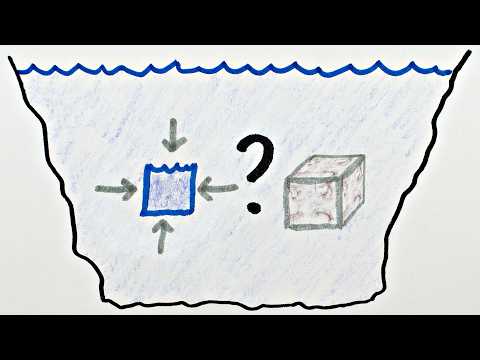
If a planet froze enough for all the CO₂ to collapse as a planet-wide dry ice glacier on top of the previous H₂O ice glacier, would the weight of the dry ice glacier melt the water ice below and make a liquid layer?
@boubakersabriahmed7794 Says:
please how do you make these videos and the animation i wanna learn it for my students in class
@raniachebihi2827 Says:
You talk too fast bro didn't even understand the principal topic of the video
@smileyp4535 Says:
Wait why wouldn't more pressure make it freeze faster??? If you put gases under pressure they can liquify 🤔🤔🤔
@Taos169 Says:
Jonny is very dizzy because he tried learning the complicated reasons why water doesn’t get as cold as you think it would the deeper you go at 0:57
@whutzPOPn Says:
what a coincidence huh?
@typerightseesight Says:
Isn't earth warmer the deeper you go?
@Tank_Plane Says:
dcmcc. C c. Ccccccc ccc c. Cl. Cm ccc m c
@simonharris4873 Says:
Isn't it the pressure that helps keep the deep ocean at that temperature?
@zahraelok5932 Says:
I love your animations! Adding this channel right next to Lead Learn Leap. You guys have similar animated videos with informative knowledge ^^ Love it
@Homer-OJ-Simpson Says:
I got so use to minute videos being 3-5 min that I left this wasn’t a minute video!
@chriscassidy9678 Says:
You didn't explain why it doesn't???
@cepavrai Says:
Can you please show down the speech speed a little bit (like 10%) , it's quite challenging to non native English speakers. Thanks
@ChokingAhogo Says:
0:59 he looks a little funky :}
@laskey2175 Says:
Great video!
@RedTail1-1 Says:
When you need that sponsor money but can't be bothered to make a full video.
@phonixedits Says:
You sound like vsauce
@craig2657 Says:
Nice video
@Abinashtutorial1 Says:
https://youtu.be/aJJfVRJZj98?si=4DFaAvzCtAuMKv6R
for clasa12
@shadow._.5622 Says:
Pls polish subtitles
@mattkampoeng Says:
Amazing
@nsTurkish Says:
Turkish subtitles please
@am-avi Says:
Pressure generates heat so how🙂it will freeze deep Ocean water😅?
@Soilderith Says:
we need more vidsss
@robert3116 Says:
Hmm, I expected it would be because water of 4 degrees is densest, so the bottom of the ocean would be constant at roughly 4 degrees?
@Adrian-f7u Says:
❤
@viliml2763 Says:
How am I supposed to find the video referenced at 0:52?
There's no title, no link, no nothing.
@safebox36 Says:
I would have thought the pressure itself _would_ have made it freeze.
@AndrewKay Says:
You could make the same video asking: "does salt keep the deep ocean from freezing?" and the answer would be "no, because the pressure means even fresh water wouldn't freeze there". Either is sufficient to prevent freezing, but it's not very sensible to say therefore that neither is an explanation. It seems like the pressure lowers the freezing point about five times as far as the salt does, though.
@rchas1023 Says:
Why should it freeze? It is closer to the ( hot ) centre of the Earth.
@CuriosityIgnited Says:
I didn’t think I’d be learning that the ocean is better at handling pressure than I am, but here we are.
@markg6914 Says:
Has anyone attempted to make a prototype craft that uses an inertial mass reduction device?
@eduardorossi7310 Says:
Even a two minutes long video with normal speee in the voice would be appreciated anyway, I presume
@vrj93 Says:
You mean to say there is no effect of hotter earth surface as we go deeper in the Ocean?
@京悪者 Says:
Would be nice if the actual video was a minute long. But no. We get 40 seconds of information and a minute of advertisement...
@Rezail_Uhhh Says:
The real question is how much pressure does it take to make ice.
@l0lLorenzol0l Says:
What about Europa? The moon of Jupiter? Would this be a factor there?
@joehopfield Says:
And the ocean is saltier the deeper you go.. What an amazing planet - would be a shame ...
@Jus10Ed Says:
Pressure does stop the Earth's core from melting though.
@Filip_Z Says:
"it doesent really get a chance" so if we would give it a chance it would
@TrogdorBurnin8or Says:
A more relevant question would be - what energy sink would cool the deep oceans?
@prospektOS-tmo97 Says:
I know you're named minutephysics and all but you could do with speaking a little slower. It's not that I can't understand it, it's that it's uncomfortable to listen to, and it's kind of cheating when it comes to making an explanation a minute long. I'd much rather stare at a longer video full of these neat little stylized minimalist drawings that for some reason comfort my soul
@phx__7 Says:
please talk a little slower, this isnt a tiktok that you are trying to have our focus before we scroll, thankyou
@magnusmarkling Says:
>salt water freezes into fresh water ice
in my experience salt water ice is very different and easily distinguishable from fresh water ice.
@herbertkraft7379 Says:
Wait. Salt water freezes as fresh water?
@ezfactz-3 Says:
The Deep Ocean and Pressure's Effect on Freezing Point
In the deep ocean, extreme pressure significantly alters the behavior of water, including its freezing point. Here’s an in-depth look at how pressure affects the freezing point of seawater in the deep ocean:
1. Pressure and Freezing Point Depression
Freezing Point Depression: Under high pressure, the freezing point of seawater decreases. In the deep ocean, where pressures can exceed 1000 atmospheres (atm), the freezing point of seawater can drop well below 0°C (32°F). This phenomenon is known as "pressure-induced freezing point depression." The pressure effectively lowers the temperature at which seawater freezes.
2. High-Pressure Phases of Ice
Ice Phases: At the immense pressures found in the deep ocean, seawater can form different crystalline phases of ice, known as high-pressure ice phases. These include Ice VI and Ice VII, which are stable at pressures much higher than those found at Earth's surface. Ice VI and VII are denser and have different structural properties compared to the common Ice I (regular ice).
3. Salinity and Freezing Point
Salinity Influence: The freezing point of seawater is influenced by its salinity. In the deep ocean, where salinity can vary, the presence of salts further lowers the freezing point. Combined with high pressure, this results in an even lower freezing point than in less saline or surface waters.
4. Pressure Effects on Water Density
Density Changes: High pressure increases the density of water, which affects how it behaves thermodynamically. In deep-sea environments, the increased density due to high pressure means that even though the freezing point is lower, the water remains in a liquid state until it reaches extremely low temperatures.
5. Supercooling in the Deep Ocean
Supercooling Phenomenon: Due to high pressure, water in the deep ocean can remain in a supercooled liquid state even below its normal freezing point. Supercooled water can remain liquid at temperatures below 0°C, and only when disturbed or when ice nuclei are introduced does it freeze. This phenomenon is significant in understanding the dynamics of ice formation in deep-sea environments.
6. Ice Formation and Seawater Chemistry
Ice Crystallization: When ice does form under high-pressure conditions, it can influence the chemical composition of the surrounding seawater. For instance, as ice forms, it excludes salt, making the surrounding liquid slightly less saline. This process, called "brine exclusion," affects the local density and pressure conditions in the ocean.
7. Deep-Sea Exploration Implications
Engineering Challenges: Understanding pressure effects on freezing is crucial for designing deep-sea exploration vehicles and instruments. These devices must withstand extreme pressures and temperatures, and engineers need to account for the unique properties of water and ice in these conditions.
8. Oceanic Ice Formations
Subsurface Ice: In certain high-pressure and low-temperature regions of the ocean, such as around hydrothermal vents, unique ice formations may occur. These formations can include "clathrates" or gas hydrates, where water molecules form a lattice structure trapping gas molecules like methane.
This knowledge highlights how pressure not only affects the freezing point but also the structure and behavior of ice in extreme deep-ocean environments. These effects are crucial for understanding oceanic processes and the adaptations of life in these harsh conditions.
@SquidGuyStudios Says:
Isnt it also because any bc ice would move to the top of the water column? I thought it worked with the same principle as lakes?
@RickGGb1 Says:
"For complicated reasons"
@David_Last_Name Says:
New management said "We are MINUTEphysics. Make the content ONE minute!!" 😁
@beebysill Says:
“Why doesn’t the bottom of the ocean freeze?”
Minutephysics: “for a bunch of intricate reasons, it just can’t ¯\_(ツ)_/¯ thanks for watching!”

















LATEST COMMENTS