Get 25% off a year subscription to CuriosityStream, ends Jan 3rd 2021: (use code "zachstar" at sign up): https://curiositystream.thld.co/zachstardec2
STEMerch Store: https://stemerch.com/
Support the Channel: https://www.patreon.com/zachstar
PayPal(one time donation): https://www.paypal.me/ZachStarYT
Join this channel to get access to perks:
https://www.youtube.com/channel/UCpCSAcbqs-sjEVfk_hMfY9w/join
?Follow me
Instagram: https://www.instagram.com/zachstar/
Twitter: https://twitter.com/ImZachStar
Animations: Brainup Studios ( http://brainup.in/ )
Check out my Spanish channel here: https://www.youtube.com/channel/UCnkNu2xQBLASpj6cKC8vtpA
?My Setup:
Space Pictures: https://amzn.to/2CC4Kqj
Magnetic Floating Globe: https://amzn.to/2VgPdn0
Camera: https://amzn.to/2RivYu5
Mic: https://amzn.to/35bKiri
Tripod: https://amzn.to/2RgMTNL
Equilibrium Tube: https://amzn.to/2SowDrh
?Check out my Amazon Store: https://www.amazon.com/shop/zachstar
Get the QED shirt over at STEMerch! https://stemerch.com/collections/qed
I know this video format was different from usual, was just way easier to do this one on a whiteboard but will be back to normal for the next one! Also I know this proof wasn't exactly as complete as you'd see in a real analysis course but was trying to make it so students of all levels could understand the kind of thinking you need for a proof like this.
P.S. For anyone wondering how this comment was posted so much earlier than the video release date, it's because I'm a wizard.
@callum6391 Says:
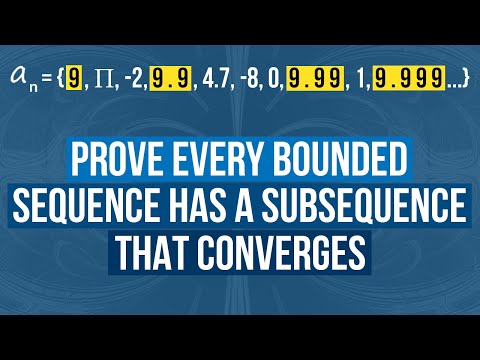
4:57 A sequence maps from the natural numbers, countable integers {1,2,3,4,5,..} and maps to some set which may have an uncountable codomain (eg. The reals) but its range will be countable e.g. {pi, 2pi,3pi,…}
@MoguMogu818 Says:
Watching this because I forgot almost everything from analysis 1 whle taking analysis 2 this semester.
@Gur7910 Says:
4:55 you have a *countably* infinite amount of numbers to choose from. they're ordered in a sequence. it's a set theory thing
@MrJ691 Says:
Been following your channel for a while. This is by far the best RA video ive seen. Its very human friendly.
@jerrythe_boy6066 Says:
came up onto my recommended about a year ago, as a freshman in highschool now studying real analysis, Bolzano weirestrass theorem got me really excited for some reasons
@EssedikAbdelRahimStudentBachou Says:
thats so cool for sure, but i always see people using sets to represent sequence, but the thing is i know from the definition that numbers cant be repeated so why dont you use ordered tuples that have the importance of both repitition and order
@HeavenlyPhilosophy Says:
Proof I thought of while the video was paused at 5:34. Edit: Interesting. The proof I thought of was not the same as the one in the video.
Imagine that you run your finger from right to left across the interval. Eventually, you will pass an infinite number of terms in the sequence through that interval, since the interval contains an infinite number of terms of the sequence. Now, there has to be a specific point where one passes an infinite number of terms, such that if your finger is any to the right of that point, it has only passed a finite number of terms. That's because you can't have half of infinity or something like that. It's a sudden jump from having passed a finite number of terms in the sequence to an infinite amount. There might be multiple points where this happens. Now, there can be no two of these points right next to each other, because that is impossible on the real number line. For any two points on the real number line, there is always a third in between them. Now, we can create an interval that is inside the interval of the original sequence such that it contains one of these infinity-passing points and no others. Now, there will be an infinite number of terms of the sequence in this interval, because if your finger passes an infinite amount on that point, it's still going to within that interval. None of the points changes. So, we can create an interval of arbitrary smallness (as long as no other infinity-passing points are inside it) such that the interval contains an infinite number of terms. We can make the interval smaller, but it will still contain an infinite number of terms as long as that point is inside of it. This is getting to the definition of a limit. We take all the terms in this interval and order them by closeness to the infinity-passing point. If two points are of equal distance, one can have an arbitrary order. Now, it will be the case that for any distance epsilon from the infinity-passing point within the interval, one can create a smaller interval containing all the points within that distance epsilon. That new interval will still have an infinite number of points because it contains the infinity-passing point, and it will exclude the first terms in the new sequence one by one because you are shrinking the interval around the infinity-passing point. So, it is the case that for any arbitrary small distance epsilon, there is a term number delta such that all the terms after term delta will be within distance epsilon from the infinity-passing point, which means that the series we created converges on the infinity-passing point. And thus, The Bolzano–Weierstrass theorem is proven.
@Luihtz Says:
I also learned this proof. It is so constructive which is why i like it. Formally proving that the sequence is a Cauchy Sequence is kind of tricky. But of u know how, it is so good!
@maxpercer7119 Says:
great video, clear and insightful - relaxed voice and presentation.
@theepicman8160 Says:
This theorem seems fairly obvious to me, i dont know why a proof is needed
@jaredhammond721 Says:
This is literally the proof that made me love math. You should have God do this proof.
@aylerayler Says:
I don't understand why it would converge on any particular number? Like I get how it can be endlessly split... bit why would it converge to any particular number? And why for instance were all the numbers he picked positive numbers?
@theultimatereductionist7592 Says:
This theorem makes use of the unstated assumption that we don't refer to a finite sequence as converging to anything.
Otherwise, the theorem would be trivially true. We seek an infinite sequence that converges.
@brunomcleod Says:
1:18 Isn't -25 less than -10?
Interesting video though, I watched this after the first video expecting it to be extremely hard to understand but it's quite interesting and not too complicated.
@Javy_Chand Says:
I cant help, but notice that the Bolzano-Weistrass Theorem is just Bisection-search, but generalized for infinite sequences...
Feels like Im learning.
@frede1905 Says:
But doesn't this proof require the principle that the real numbers is complete (that every Cauchy sequence converges), or alternatively that the intersection of an infinite sequence of nested closed intervals is nonempty (so there is an element of the real numbers that is common to all these nested intervals). The last property relies on the fact that closed intervals are compact. Proving either of these (that the real numbers is complete, or that closed intervals are compact) is not easy, and may even require the Bolzano Weierstrass theorem in the first place (although there are probably proofs of these facts that doesn't require that theorem). In any case, this proof seemed quite incomplete.
@fombung8301 Says:
Really nice but how do I explain this in an exam?😏
@tmann986 Says:
10 real world applications I can use in my life tonight; go!
@MathPhysicsEngineering Says:
Dear friends,
I also made a video about this theorem which is very visual and at the same time very rigorous, I believe you will like it.
I made two proofs of the Bolzano Weierstrass theorem, one based on the monotone convergence theorem, which works only for the real line (without proper modifications) as
it exploits the order properties on the real line. The video on my channel is called:
"Easiest Proof of the Bolzano–Weierstrass Theorem"
The other video exploits Cantor's lemma as is done in the current video:
Visualized Proof of the Bolzano-Weierstrass Theorem using Cantor's lemma
I'm currently recording a visual and rigorous course on calculus where I introduce ideas from topology and metric spaces early on look it up on my channel.
I would also like to recommend my video called: Visual Proof of The Heine-Borel Theorem and Compactness of [a,b]
It has some sound issues but I'm very happy with the visual quality and the rigor of the video.
@brockobama257 Says:
I’m currently in real analysis and the rigorous proof is easier than comprehending the concept. So I don’t actually understand what I’m doing.
@antonbashkin6706 Says:
That's really cool!
@anshumanagrawal346 Says:
What guarantees that you can keep doing this? What if both the intervals contain infinitely many terms? Wouldn't require like AOC?
@joelarulanandam6248 Says:
where and how it is applied on economic
@adithyabharath6453 Says:
can you please start real analysis video series no one on youtube explain in this way
@amyholmes8373 Says:
Thank you so much! I have an exam tomorrow and your simple explanation helped so much!
@Jack_Callcott Says:
I remember being blown out by this theorem when I was studying real analysis many moons ago. I wonder if it requires the Axion of Choice.??
@sanjursan Says:
How about displaying a statement of the theorem.
@dougdimmedome5552 Says:
Also notice how this idea of constantly creating nested intervals, all enumerated by natural numbers out to infinity at some point doesn’t terminate at least one value, and what that says about how the natural numbers map onto the real numbers, and also even more how this behavior of real numbers is necessary for calculus itself to work.
@Senya7893 Says:
that is the best explanation I found so far.
thank you !
@eityafackmullick Says:
Happy totake Engineering as major
@farhanzakaria-o9t Says:
As a guy who has read that book and attempted it's problems, I really enjoyed this. (The first chapter, 20 pages took me 3 days. At the end, I had a nervous breakdown)
@michalcohen7747 Says:
the way we learned this at my first semester in college 🥴
@danielking8475 Says:
How would you prove that the subsequences converge to the same limit using this technique?
@philumen948 Says:
anyone else irritated by that -25 in there
@dakota5569 Says:
I actually had a lot of fun in my real analysis class, even if I didn’t understand what I was doing until the end.
@admann24 Says:
Yes . . . I have no clue what is happening.
@quant-prep2843 Says:
MATH INTUITION GOD
@raytheboss4650 Says:
why do you look like eric rosen when your not facing the camera !
@SimonK91 Says:
Totally off topic, but pikachu @2:18
@TheSentientCloud Says:
God good proofs are SUPER fucking sexy 🤤🤤🤤
@mattgsm Says:
sigmoid function is bounded and yet it has no repeated numbers
@derblaue Says:
This proof is acutally not that hard. Even if you do it the proper analysis way.
@somasundaramsankaranarayan4592 Says:
You have proved that the sequence is cauchy. Showing cauchy is convergent when dealing with reals will finish your proof.
@alfredholmes9899 Says:
Other proof: pick the (possibly finite / empty) subsequence containing elements of the sequence that are greater than all the elements that follow. This sequence is decreasing so, if infinite, is a convergent subsequence. If this sequence was finite / empty then the original sequence has an increasing subsequence (each element is not an upper bound) and so this subsequence converges.
@theVERYbadbanana Says:
Great video! But I'm curious wheather you can denote a sequence using {} brackets. It seems like something confusable with a set, which I think wouldn't work as a sequence? Sorry id that's a trivial question.
@euclidselements9522 Says:
it's just because you're always splitting it in two
@mtembugoitsemangjohannes7541 Says:
What is the meaning of subsequence?
@Amira_Phoenix Says:
it looks more like a philosophical proof, rather than mathematical one.
@anthiekladaki1051 Says:
We did that in the 12th grade of my country, at least people who wanted stem and not bio or humanitarian studies, is this the norm in the us?



















LATEST COMMENTS